Paradigm · Geometry · laGEOsis
Pure Lane Geometry
What if we paint the Laegna number's internals straight — as a number hologram — instead of minimizing the error of angle and length symmetries? The memory pixel is a perfect dot on a square field, so it projects perfectly onto the ball. In Laegna GEOdesis the unit square has side 1 and diagonal 1: a circle scoped to infinity.
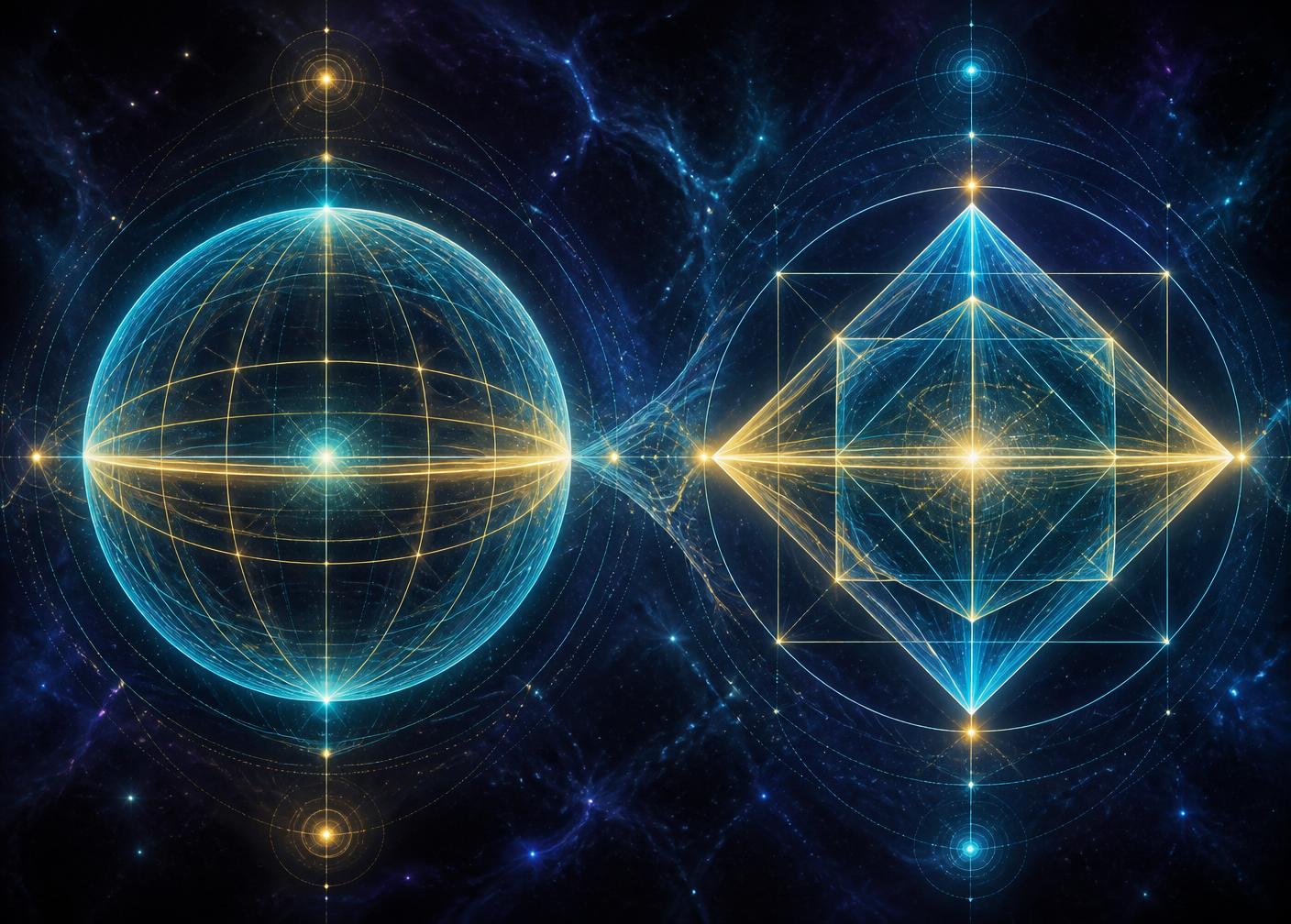
Project the ball to an octahedron and two perfect squares appear — north and south hemispheres — while the equator is one square's side. Diagonals equal twice the parallels: the pure lane 1:1 and 1:2 symmetries.
Ball → Octahedron → Two Squares
Project the ball to an octahedron and two perfect squares form — the north and south hemispheres — while the equator is a single square whose length is one side. Because the squares are made of equilateral triangles, their diagonals equal twice their parallels.
- ◆South hemisphere — the linear system: its 2×2 band is linear, its 4×4 band exponential.
- ◆North hemisphere — the exponent system: bands swap, "as above, so below".
- ◆Equator — one square's side; the whole latitude circle.
Raise the space's dimensionality by a power of 4 until each square's curvature equals the original — this octave growth makes the square perfectly symmetric to the circle.
Two sources of one lane
Pure Lane has two generators. Infinity is open recursion that never collapses; the ball is the closed unit whose surface is straight while its projection stays normal. In Laegna the unit square has side 1 and diagonal 1 — a circle scoped to infinity — so the two meet.
∞ — Open recursion
- ·Non-collapse, infinite propagation
- ·O-band openness, unknowns spread
- ·A single digit is one infinitesimal of true infinity
◯ — The unit ball
- ·Surface straight, projection normal
- ·Unit square: side 1, diagonal 1
- ·Fractal ball = hologram head recurring
Repeating decimals reveal the seam: 0.(9) = 1 loses one tenth of a digit — a half-infinitesimal that reappears in the Z octave, a butterfly inside the butterfly. The ball closes what infinity keeps open, and each is the other's pure lane.
The 4×4 hologram
Internal space (2×2)
Locally projected on X,Y = −1..1 with zero omitted. On both axes lives one Laegna digit: IO⟷AE is bit 1, IA⟷OE is bit 2.
External space (4×4)
Outer space is size 16; internal size 4. External alone has power 12: (I+E)−I = E, i.e. 16−4 = 12.
Laegna-16 / Complex
Two axes of IOAE give 4D KJIL QPOR CBAD GFEH — the Laegna Complex system, with KPAH as its diagonal.